Verify and pay
The customer flow must communicate eligibility, price, verification, payment, dispense, and support in the right order.
A reader that accepts a tap is only one component. A production vending route must connect merchant underwriting, customer verification, payment authorization, dispense status, settlement, remote support, refunds, and reconciliation without losing the truth between systems.
Unattended vending payment processing is not ordinary countertop card acceptance with the cashier removed. The payment platform must know which machine originated the transaction, the machine must know whether the payment is usable, and the operator must be able to separate a decline from a device problem, a verification failure, or an approved payment followed by a failed dispense. If those states collapse into one generic “error,” support becomes guesswork and every exception becomes a chargeback risk.
This guide is for operators buying or financing a connected vending system, especially when the merchandise has an age gate. It explains what belongs in the payment review, which proof to request, and why a separate merchant application is still required even when the cabinet, software, and payment terminal are sold together.
The customer flow must communicate eligibility, price, verification, payment, dispense, and support in the right order.
The machine must preserve both the payment outcome and the physical vend outcome instead of treating them as one event.
The remote platform must expose transactions, faults, inventory, refunds, taxes, and settlement evidence at the machine level.
A payment terminal may be technically compatible with a vending controller and still be wrong for the merchant account. The processing relationship is approved for a legal business, products, locations, expected transaction pattern, refund practice, and device configuration. Age-restricted products can require additional review. The operator should disclose the actual deployment rather than applying for a generic retail account and assuming unattended sales are covered.
A complete onboarding package usually starts with the business and beneficial-owner information, settlement account, processing history or projections, products, fulfillment model, locations, average and high ticket, refund policy, and the hardware/software flow. Approval terms can include pricing, funding timing, limits, reserves, device requirements, and other conditions. They are not final until the processor or underwriter approves the account and the parties complete the applicable documents.
For the AgeVend AV-1, AgeVend publishes the selected payment path and states that a separate payment application and approval are required. Review the primary-source AgeVend vending-machine payment processing guide for the current machine-specific commercial disclosure, then use this page to evaluate the broader operating workflow.
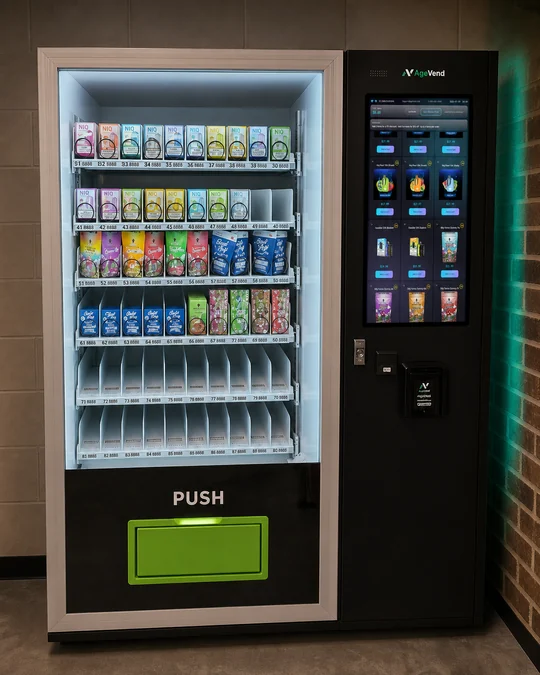
The cabinet, customer kiosk, age-verification flow, payment terminal, vending controller, inventory record, fault queue, and remote dashboard all participate in the sale. Test the connections between them—not just each component alone.
The most important question is not “Which cards does it take?” It is “What evidence survives when something goes wrong?” A useful transaction record distinguishes at least the following states:
| What happened | What the system should preserve | Operator action |
|---|---|---|
| Verification did not complete | No payment authorization should be represented as a completed sale. Preserve a support-safe reason without exposing customer identity data. | Guide the customer to the approved fallback or support path. |
| Payment declined | Decline state, machine, time, amount, and safe response context; never label it as a machine fault. | Allow another permitted payment attempt or end the sale. |
| Payment approved, dispense succeeded | Payment reference, product/slot, vend result, tax, machine, and settlement linkage. | Normal reconciliation and inventory decrement. |
| Payment approved, dispense failed | The approval and failed vend as two facts connected to one customer-facing attempt. | Remote refund, service recovery, or another approved resolution. |
| Outcome unknown | A durable pending/unknown record that can be reconciled before any retry. | Check the platform or processor outcome; never blindly recharge. |
That last row is where weak integrations become expensive. If the network drops after the payment host responds, the kiosk may not know whether the card was charged. Retrying immediately can create a duplicate. Treat “unknown” as a real state, reconcile it to a final answer, and make the next action explicit.
A card authorization confirms the payment host’s decision; it does not prove a motor turned, a product cleared the delivery path, or the customer received merchandise. The vending controller and remote platform should record the dispense result independently. Before launch, create a safe test condition that produces an approved payment and a controlled vend exception, then confirm the operator can see and resolve it.
“Supports refunds” is too vague. Ask whether a settled vending transaction can be found remotely, which roles may refund it, whether partial refunds are supported, how the original transaction is identified, and what happens when the payment configuration does not expose a reusable transaction reference. Run the exact workflow in a safe environment and capture the evidence for the operating playbook.
The operator dashboard should also keep payment faults separate from machine faults. A communications outage, terminal configuration error, verification interruption, empty slot, motor jam, and failed settlement are different work queues. Routing every issue to “service machine” wastes trips and obscures the financial exception that actually needs attention.
Compare proposals on the complete deployment rather than one headline percentage. Request the processing pricing model and markup, per-item or authorization fees, gateway or platform fees, device/connectivity costs, chargeback and retrieval fees, verification usage fees, settlement timing, reserves if any, and any software costs. Then separate those payment costs from machine purchase, freight, installation, inventory, licensing, venue economics, tax, and ongoing route service.
The AgeVend AV-1 currently publishes a card-processing rate through Lifted Payments and separate verification economics on its primary product pages. Those figures apply to the described AgeVend configuration and remain subject to the required merchant application and approval. Other merchants and deployments are quoted after review. Do not transfer one machine’s published commercial terms to another business, product set, or processing configuration.
The bank deposit is the end of the payment chain, not enough evidence to run the route. Daily review should connect machine transactions, approved amounts, refunds, failed dispenses, taxes, product movement, terminal batch or platform totals, processor reporting, and the funded deposit. Differences need an owner and a reason. If the platform can only show a portfolio total, a multi-machine operator cannot tell whether one cabinet is offline, a reader is misconfigured, or a location is underperforming.
Useful access controls matter here. The person restocking inventory does not automatically need refund authority; the person reviewing settlement may not need machine-control privileges. Ask for role-based access, audit history, and a process for removing a team member promptly.
For the machine, site, product, verification, tax, inventory, lab-report, and remote-operations portions of the same decision, use the full AgeVend age-verified vending buyer checklist. It is designed to be printed and attached to the operator’s written deployment scope.
Start the secure merchant application, disclose the unattended deployment, and let Lifted Payments configure the approved payment path around the machine and operator.