Start with an eligible commercial card.
Corporate, purchasing, government, and other commercial products can follow program rules that consumer cards do not. Card product and transaction context come first.
Use live reporting and eligible remote refunds today, with a tokenized saved-card charge workflow in release gating, and keep operations in one Lifted-managed product. For eligible B2B, corporate, purchasing, and government cards, Lifted Gateway can submit the Level 2 and Level 3 fields needed to pursue the applicable commercial-card interchange qualification. New to this? See our guides to B2B credit card processing and lowering your processing fees.
Updated August 3, 2026 · Network sources and qualification language reviewed.
Illustrative. Lifted Gateway can attach configured fields, but actual interchange qualification depends on card type, current network rules, submitted data, and acquirer configuration.
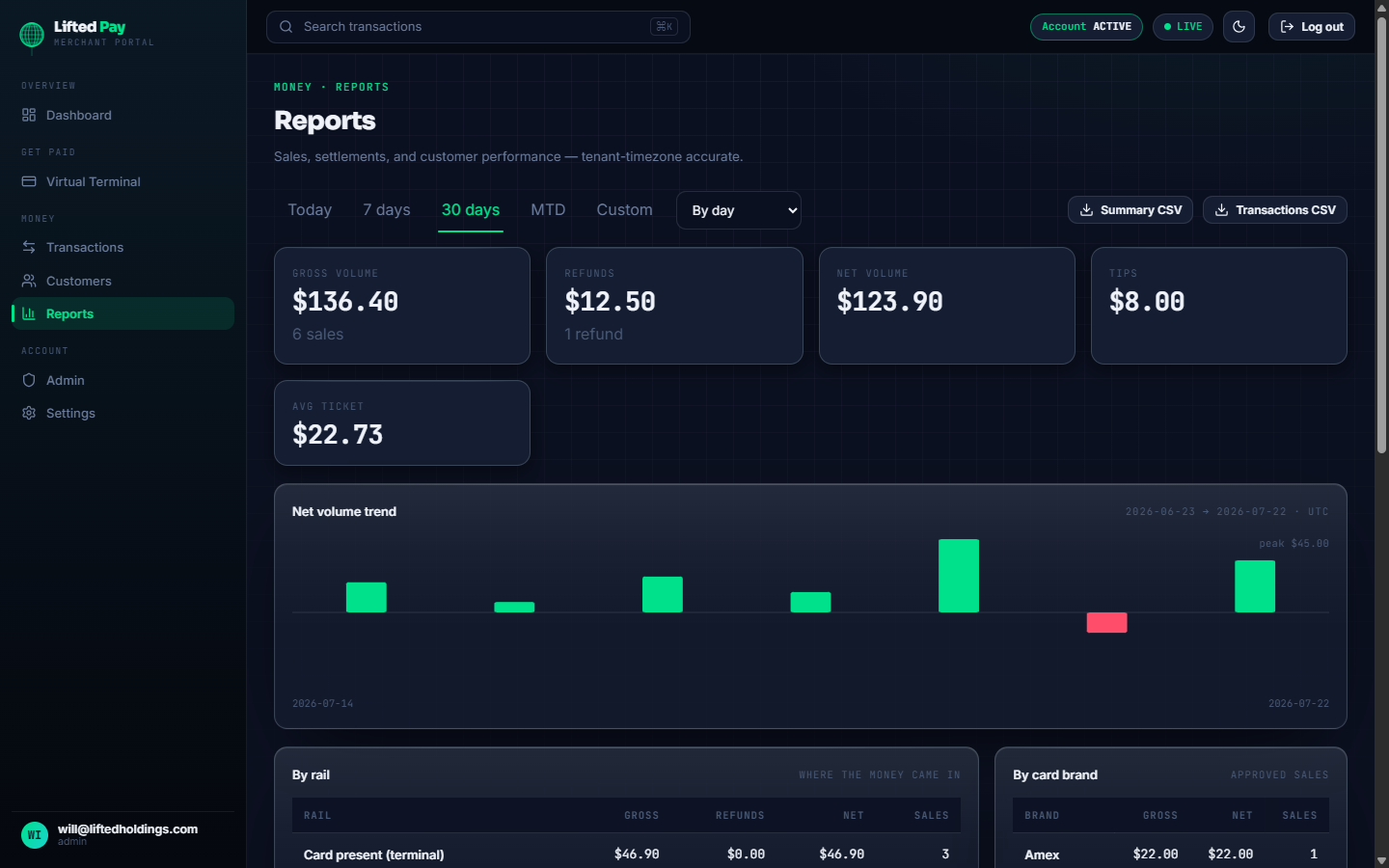
The reel starts with Lifted's live reporting interface, shows the saved-card charge product preview, and closes with the live workflow for refunding a qualifying completed transaction. Saved-card self-service remains in release gating.
Commercial-card programs can evaluate tax, customer, invoice, PO, and line-item fields alongside card type and other current criteria. Lifted Gateway can append configured fields on eligible transactions.
Interchange optimization with Level 2/3 data is a qualification process, not a universal discount. A correctly enriched commercial transaction may qualify for a different interchange category when it meets every applicable network and acquirer criterion; the goal is to submit the valid fields those current programs expect.
Corporate, purchasing, government, and other commercial products can follow program rules that consumer cards do not. Card product and transaction context come first.
Lifted Gateway can append configured tax, customer, invoice, PO, and line-item fields on eligible transactions without repetitive staff keying.
The network and acquirer assess the card, data, timing, transaction, and current program rules. Enhanced data can help, but does not guarantee a particular interchange category or savings.
Check the primary sources: Visa's current U.S. interchange reimbursement fee table and Mastercard's merchant interchange guidance. Published tables and criteria change; your assessed result is transaction-specific.
Wholesalers, distributors, and suppliers whose buyers pay with corporate and purchasing cards can evaluate the effect of valid enhanced data across meaningful commercial-card volume.
Vendors invoicing agencies, districts, and universities on GSA and purchasing cards — where L2/L3 detail is often required, not optional.
Any business taking a meaningful share of corporate or commercial cards can review qualification transaction by transaction instead of assuming one rate applies to every sale.
The same product that supports richer commercial-card data gives merchants live operating visibility and refunds for qualifying completed transactions. Its saved-card browser charge workflow remains in release gating. It can sit alongside Lifted Pay, Lifted POS, and the merchant portal.
We'll read your current statement, show you the true all-in blended rate, and quote interchange-plus with commercial cards optimized on Level 2/3. No application fee.